Use your own counts in the colour-budget calculator ↗
Original calculation exercise. All sample measurements are invented for teaching; this is not a tested crochet pattern or a report of a finished project. Replace them with measurements from your own fabric.
A project can have enough yarn in total and still run out of one shade. This case builds a colour-by-colour shopping list for five columns and seven rows of single-colour motifs. The central question is which components draw from each supply.
Count the rows before dividing the yarn
Use the sequence A, B, C, A, B, C, A from top to bottom, five motifs in every row. That gives three A rows and two each of B and C. Mark a reading direction on your real layout so it remains clear when you turn the work over.
Open the 35-motif row arrangement ↗. The letters are colour identifiers, not stitch symbols. The example uses the same 14 cm square, 0.4 cm join and 2 cm border inputs as the linked planner.
Checkpoint: does each colour need one third of the motifs?
No. A has 15 motifs, while B and C have 10 each. The repeated sequence is balanced over each group of three rows, but the seventh row adds five more A motifs.
Assign the extra work to a colour
For this exercise, each motif uses 18 g, measured in the same construction. In a real project, weigh representative samples for each yarn or construction instead of assuming that equal-looking motifs weigh the same.
All internal joins and the outside border use C. The shared-edge length is (4 × 7 + 6 × 5) × 14 = 812 cm. An invented representative sample uses 3 g per 40 cm of join, so the seam estimate is 812 × 3 ÷ 40 = 60.9 g. The border has a separate estimate of 95 g, supplied as an input for this exercise; its value cannot be inferred from motif counts.
The seam model counts each shared edge once. It excludes junction-specific work and assumes the sample represents the method you will use. See the join-estimation method before applying it to another construction.
| Colour | Motifs | Motif yarn | Other components | Base total |
|---|---|---|---|---|
| A | 15 | 270 g | None | 270 g |
| B | 10 | 180 g | None | 180 g |
| C | 10 | 180 g | 60.9 g joins + 95 g border | 335.9 g |
Apply the margin, then round each supply
Choose 12% as an illustrative margin on each colour's base total. This is a planning assumption, not a measured error range or a recommended universal percentage. All three colours come in 100 g balls in this example.
| Colour | Base × 1.12 | 100 g balls | Purchased mass |
|---|---|---|---|
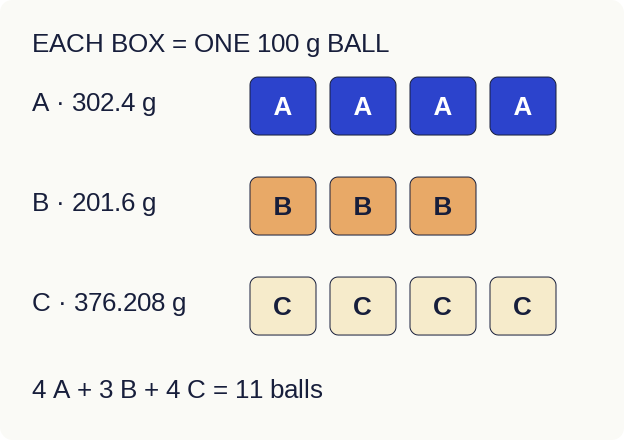
| A | 302.4 g | 4 | 400 g |
| B | 201.6 g | 3 | 300 g |
| C | 376.208 g | 4 | 400 g |
The list is four A, three B and four C: eleven balls. Dividing the combined estimate of 880.208 g by 100 and rounding once gives nine balls. That pooled answer cannot satisfy all three separate requirements. The small overages above 300 g and 200 g push A and B across whole-ball boundaries.
Checkpoint: can spare C replace the fourth ball of A?
Only if you deliberately change the design and reallocate the components. Spare yarn in one shade is not interchangeable with another shade in a fixed colour plan. Recalculate the affected rows before reducing the purchase list.
Read the diagram as text
A needs three hundred two point four grams, so four one hundred gram balls. B needs two hundred one point six grams, so three balls. C needs three hundred seventy six point two zero eight grams, so four balls. Eleven balls in total.
Check the result before a bulk purchase
A or B might need another ball solely because of the chosen margin. That is a reason to examine sample quality and what the margin covers, not automatically to delete the margin. Keep the base estimate and allowance visible so you can revise the assumption honestly.
Record product and shade codes, batch information where supplied, and which components use each colour. If a new joining method or a larger border changes C, update C's line rather than multiplying the whole project by another hidden percentage.
After a representative batch, compare actual consumption with the estimate. Store the colour allocations in the project record; the planner's screen colours do not identify real yarn products or dye lots.