LmLoop & MeasurePlan a blanket
Home/Tools

Plan, check, understand

Yarn budget by colour

Turn motif counts into a separate purchase list for each shade, including extra components, your chosen margin and usable yarn you already own.

Your project

Loading replaces the current inputs. These invented measurements teach the calculation; they are not a tested pattern. A kept Plan A is preserved.

The margin applies to motifs plus extra components, before subtracting your stock. Twelve percent is an example, not a universal recommendation.

Motif weight, extra grams and stock: what goes where?
  1. One motifMeasure grams for one complete single-colour motif. Count how many of that motif you will make.
  2. Other componentsAdd base grams for seams, border or finishing assigned to that shade. Do not include them again in motif weight.
  3. Margin, then stockThe tool adds your percentage to the base requirement, then subtracts the usable grams already owned.

Illustrative example: 10 motifs × 18 g + 20 g edging = 200 g base. With 10% margin, you need 220 g. If you already own 70 g, the shortfall is 150 g: two new 100 g balls. Spare yarn in another shade does not cover this shortfall.

Colour A
Colour B
Colour C
Shopping costs

Use prices per single ball including applicable tax. Blank prices are unknown, not free. Shipping is added once. Existing stock's historical cost is excluded. There is no currency conversion.

Use single-colour motifs. Put 0 motifs and 0 extra grams for an unused colour. Multi-colour motifs need separate consumption measurements for each shade; this tool does not infer those from a picture.

Example inputs are provided. Replace them with your own measurements. Entries stay on this page. Download a text copy to keep them; nothing is uploaded.

The worked example below explains how this tool works.

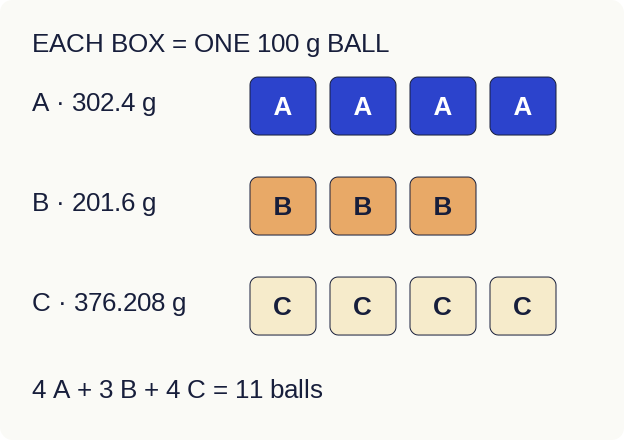
Example: 302.4 g of A requires four 100 g balls; 201.6 g of B requires three; 376.208 g of C requires four.
Round each shade separately. Each box represents a 100 g ball. These are the teaching case's estimates including its 12% allowance, not measurements of your project.
View full-size diagram ↗

Keep the colours separate until after rounding

A combined yarn total cannot tell you how many balls of each shade to buy. This calculator treats A, B and C as separate supplies. You can name them after the actual shade codes, enter different ball weights and include usable stock. Spare A never silently pays for a shortage of B.

Base = motifs × grams per motif + extra component grams
Required = base × (1 + allowance / 100)
Shortfall = max(0, required − usable stock)
New balls = round shortfall / ball weight UP

Allocate each component once

Measure the consumption of a representative finished motif in each relevant yarn. If C supplies all seams and the border, enter those component estimates in C's extra-grams field. The extra inputs are base estimates before this tool's margin. Do not enter an already-inflated component estimate unless you intentionally want another margin applied to it.

Stock means usable material of the right product, shade and acceptable batch. Exclude uncertain remnants or yarn already promised to another component. The model subtracts stock after calculating the requirement with its margin; it does not apply a percentage to your inventory.

Follow the supplied example

A has 15 motifs and B and C have 10 each, at 18 g per motif. C also needs 155.9 g for joins and border. With a 12% margin and no stock, the requirements are 302.4 g, 201.6 g and 376.208 g. Buying 100 g balls gives 4 A, 3 B and 4 C.

If you already have 120 g of A, its shortfall becomes 182.4 g and it needs two new 100 g balls. The unused amount shown is stock plus purchased grams minus the estimate. It is not a prediction of exactly what will remain after making the project.

Get the counts from a layout

The blanket planner provides a colour count for its three-colour arrangements and can transfer those counts here. You still supply the measured consumption: a count of squares is not a weight of yarn. Follow the 35-motif budget case to see how the seam and border inputs were established.

Totals are rounded for display only. Purchase decisions use the underlying values. When an estimate lies just above a whole-ball boundary, another ball may be required; inspect your measurements and chosen allowance before deciding to remove that margin.