Calculate a stopping point for your own supply ↗
Original calculation exercise. All sample measurements are invented for teaching; this is not a tested crochet pattern or a report of a finished project. Replace them with measurements from your own fabric.
Most yarn calculators start with a size and estimate a purchase. A stash project starts with the opposite constraint: the available supply is fixed. This exercise works backwards to an area budget, then checks whether the stitch and row counts still fit inside it.
Separate available yarn from promised yarn
| Input | Value | Why it matters |
|---|---|---|
| Available supply | 400 g of one known yarn and colour | Use actual usable yarn, not the original mass of partly used balls |
| Reserved for other components | 40 g | Already budgeted for the intended border/finishing work |
| Main-fabric allowance | 10% | Applied to the base main-fabric estimate only |
| Whole sample | 20 × 15 cm, weighing 12 g | Finished, dry and representative of the main fabric |
| Required main-fabric width | 80 cm | Border is outside this width |
| Gauge | 16 stitches and 14 rows per 10 cm | Measured in the relevant stitch pattern |
| Row repeat | 4 rows | The construction must finish at a full repeat |
The 40 g reserve is an input, not a border recipe. Establish it from the planned construction before trusting the rest of the budget. The result below describes the main rectangle; it does not give the finished outside dimensions with its border.
Work backwards without spending the allowance twice
- Leave the reserve aside: 400 − 40 = 360 g for the main fabric including its margin.
- Remove the 10% multiplier: 360 ÷ 1.10 ≈ 327.27 g base-fabric budget.
- Find sample density: 12 ÷ (20 × 15) = 0.04 g/cm².
- Convert mass to area: 327.27… ÷ 0.04 ≈ 8,181.82 cm².
- At 80 cm wide, the continuous length ceiling is 8,181.81… ÷ 80 ≈ 102.27 cm.
Keep full precision during the calculation; the displayed decimals are rounded. Subtracting 10% from 360 g would not exactly undo multiplying a base estimate by 1.10. Division reverses that multiplier.
Checkpoint: is 102.27 cm a finished pattern instruction?
No. It is a continuous geometric ceiling under the assumptions. Whole rows, the row repeat, setup instructions and actual yarn consumption still have to be checked.
Round down to a complete stopping point
The row gauge is 1.4 rows/cm. The ceiling corresponds to about 143.18 rows. Rounding to the nearest whole row is not enough: the four-row repeat permits 140 or 144 rows around this point. Choose 140 rows to remain within the budget.
At the measured gauge, 140 ÷ 1.4 = 100 cm of main fabric. Width needs 80 × 1.6 = 128 working stitches. This case assumes a compatible one-stitch width multiple; the original pattern still determines setup chains and any edge treatment.
| Rows | Main-fabric length | Base grams | With 10% plus 40 g reserve |
|---|---|---|---|
| 140 | 100 cm | 320 g | 392 g |
| 144 | 102.86 cm approximately | 329.14 g approximately | 402.06 g approximately |
Check the 80 × 100 cm main rectangle in the yarn calculator ↗. It reports 352 g including the 10% allowance. Add the separately held 40 g reserve to obtain 392 g. The tool does not know about that reserve and must not apply the margin to it again.
Read the diagram as text
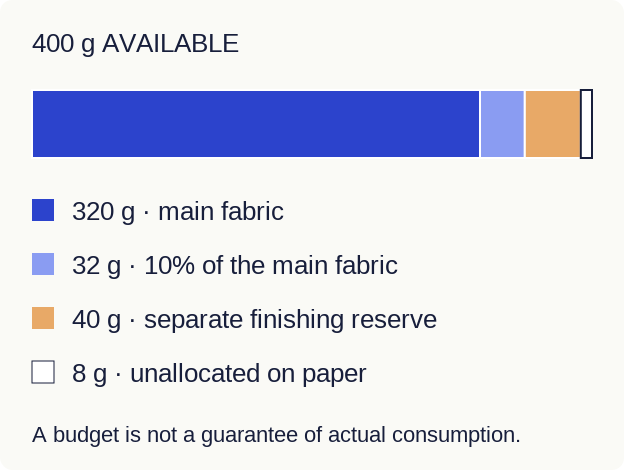
The four hundred gram supply is divided into three hundred twenty grams of main fabric, thirty two grams of allowance, forty grams reserved for finishing and eight unallocated grams.
Understand the remaining eight grams
The chosen plan leaves 400 − 392 = 8 g unallocated on paper, after the explicit margin and reserve. It is not a promise that exactly eight grams will remain at the end. A sample that is unrepresentative, a scale reading error or a change of tension can consume the apparent slack.
If the same whole sample weighs 13 g rather than 12 g, an 80 × 100 cm rectangle has a base estimate of 346.67 g. With the 10% margin and reserve, it needs about 421.33 g, exceeding the supply. A larger, repeatably weighed sample is more useful than a longer string of decimal places.
Choose a plan you can stop and check
Start with a checkpoint well before the planned end. Weigh the remaining yarn and measure completed main fabric using the same method as the sample. Keep reserve yarn separate so an attractive extra repeat does not quietly consume the border budget.
If the rate differs, shorten the main rectangle at a valid stopping row, reconsider width before continuing, or obtain matching yarn. Do not use this rectangular model for shaped garments or three-dimensional pieces. Save the supply, reserve, margin and stopping-row decision in the project record.