Work backwards from usable supply
This planner estimates a flat rectangle made in one consistent fabric. First it holds the finishing reserve aside. It then removes the main-fabric allowance multiplier, converts the remaining base grams into an area using your sample and divides by the width. Finally it rounds down to a complete row repeat.
Density = whole sample grams / whole sample area
Length ceiling = base budget / density / width
Rows = complete repeats that fit below the ceiling
The reserve and allowance have different jobs
The reserve is a separate input for work such as edging. Establish it using that component's own construction. The allowance is an editable margin on the main-fabric estimate. The tool does not inflate the reserve again. A 10% example cannot compensate for a sample that uses a different stitch or yarn.
Check the default plan
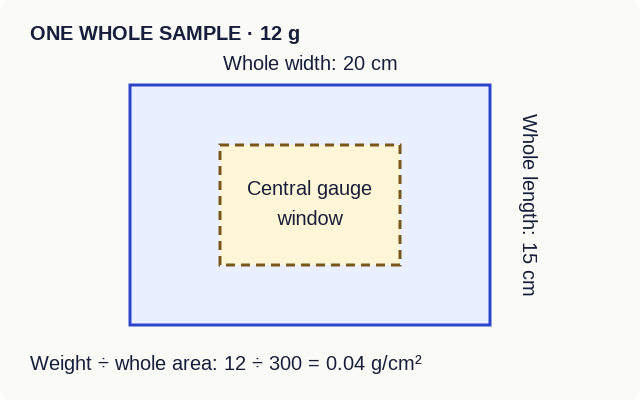
With 400 g available and 40 g reserved, 360 g remains for the main fabric including its 10% margin. A whole 20 × 15 cm sample weighing 12 g gives 0.04 g/cm². At an 80 cm main width, the continuous ceiling is about 102.27 cm.
A gauge of 14 rows per 10 cm and a four-row repeat permits 140 rows, or 100 cm. That uses an estimated 320 g plus 32 g allowance and the 40 g reserve: 392 g in total. The next repeat would require about 402.06 g, so it exceeds the supply. These are invented exercise measurements, not a tested pattern.
Read the result's boundaries
The length belongs to the main fabric, not the outside measurement after adding a border. This calculator does not set the foundation chain or check stitch multiples across the width. Use the stitch calculator and the original pattern to confirm that width before accepting the estimate.
If even one row repeat does not fit, the tool reports that outcome rather than pretending a zero-row piece is a workable project. Consider a narrower suitable design, a smaller complete repeat if the pattern allows it, or more yarn. Shaping, mixed fabrics and instructions with separate setup or ending rows need their own calculation.
Weigh and measure a representative section while you still have room to adjust. The unallocated grams are a numerical remainder after the explicit margin, not a guarantee against running out. See the fixed-supply case for a sensitivity check using a different sample weight.