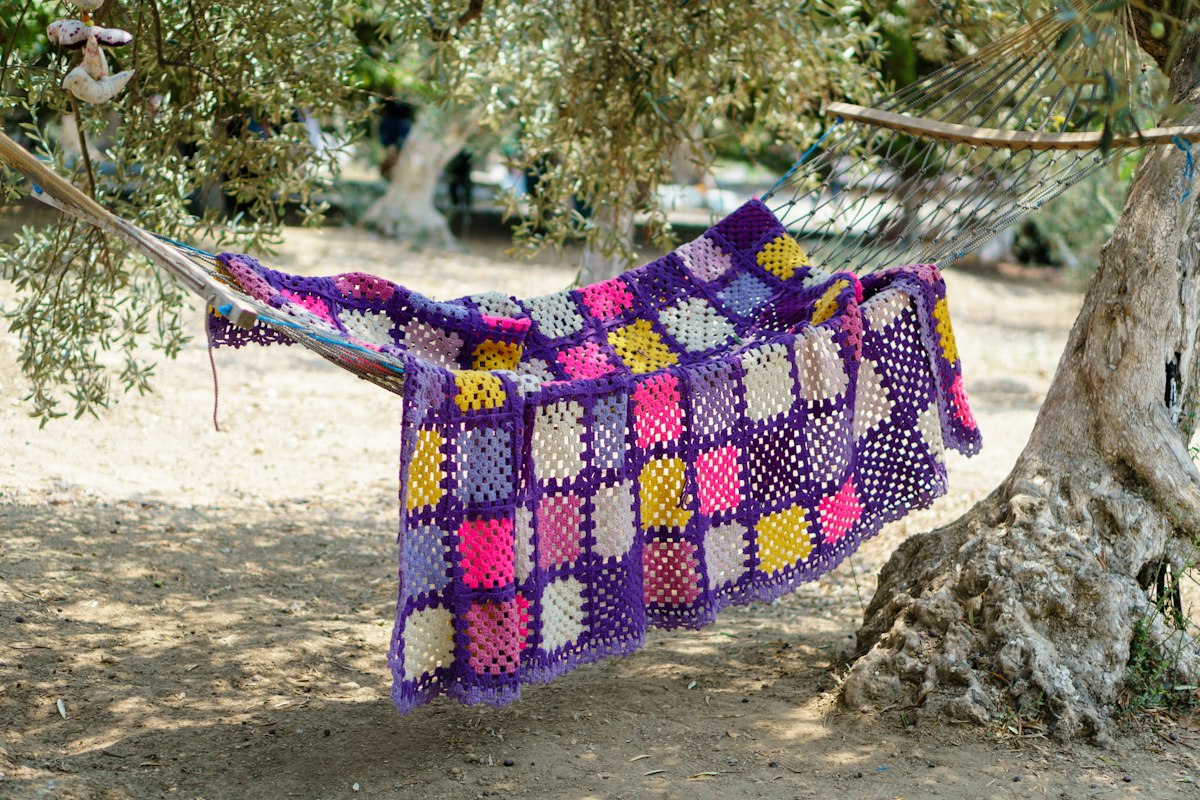
Original calculation exercise. All sample measurements are invented for teaching; this is not a tested crochet pattern or a report of a finished project. Replace them with measurements from your own fabric.
Your finished blanket needs to stay within 90 × 120 cm. You have a square-motif design you like, but the nearest layout is not automatically small enough. This case follows the decision from the first calculator result to a written plan.
Set the constraint before choosing a layout
| Input | Value | Meaning |
|---|---|---|
| Finished size limit | 90 cm wide × 120 cm long | Outside dimensions, including the border |
| Finished square | 12 × 12 cm | After the intended care treatment |
| Additional join width | 0.4 cm | Extra width observed in a joined pair |
| Planned border | 2 cm each side | Uniform depth around the assembled centre |
Use the width and length limits separately. Rotating the rectangle is a separate design choice, not a way to pretend an oversized side fits. The square and join figures describe the same finishing condition; mixing an unwashed square with a finished join introduces an unknown change.
Read the nearest result as a candidate
Across the width, the unrounded number of motifs is (90 − 4 + 0.4) ÷ 12.4 ≈ 6.97. The ordinary planner rounds that to seven. Length rounds to nine. Its result is 7 × 9 = 63 squares, measuring 90.4 × 115.2 cm.
Load this case in the blanket planner ↗. The extra 0.4 cm of width matters because the brief is a maximum. The tool has performed its advertised nearest-size calculation correctly; it has not checked a hard size constraint for you.
Checkpoint: is 63 squares an acceptable answer?
Not with the stated 2 cm border and strict 90 cm width limit: the calculated width is 90.4 cm. Being close is different from fitting. Keep the length result, but reconsider columns, the border or the motif size.
Compare three explicit choices
| Option | Motifs | Outside size | Decision |
|---|---|---|---|
| 6 × 9; 2 cm border | 54 | 78 × 115.2 cm | Below both limits, with a noticeably narrower shape |
| 7 × 9; 2 cm border | 63 | 90.4 × 115.2 cm | Exceeds the width limit |
| 7 × 9; 1.8 cm border | 63 | 90 × 114.8 cm | Exactly on the width limit; no width margin |
A uniform border change affects both dimensions. Reducing it by 0.2 cm removes 0.4 cm from width and length, not 0.2 cm. It also changes the design: confirm that the chosen border instructions can produce that depth rather than stopping partway through a decorative repeat.
Test how fragile an exact fit is
Suppose the actual finished motifs measure 12.1 cm instead of 12 cm. Seven columns with six joins and the 1.8 cm border become 7 × 12.1 + 6 × 0.4 + 3.6 = 90.7 cm. Nine rows become 115.7 cm long. A tenth of a centimetre per motif has removed the apparent fit.
This is a sensitivity example, not a claim about the accuracy of your ruler. Measure several representative motifs and an assembled sample. A finished fabric can also relax under its own weight. If the limit matters, choose a deliberate margin and check the actual assembled piece instead of treating a decimal result as a physical guarantee.
Write the chosen trade-off
For a firm width limit, the 6 × 9 option gives more numerical room. Its narrower shape may be unsuitable, in which case the useful next step is a different motif design or a new sample size, not stretching or compressing the existing plan.
A reproducible note is: “Maximum outside size 90 × 120 cm. Provisional layout 6 × 9; 54 motifs; calculated 78 × 115.2 cm. Compare actual assembled width after joining the first complete row.” Add yarn and care details in the project record.
Next, budget the colours and components. A layout count alone does not measure joining yarn or explain how much of each shade to buy.