Start with observations you can repeat
A widening rectangle might contain extra stitches, larger stitches or both. A screenshot of its outline would not settle that distinction, and this helper does not inspect an image. It uses your answers to choose the next useful checks. Each route links to the relevant counting or measurement explanation.
Why the expected shape comes first
Increases, decreases and some textures deliberately change an outline. If the section is shaped or its intended behaviour is unknown, the first step is the original pattern. Comparing a shaped row with a constant-count rectangle would turn a correct design feature into a supposed mistake.
Two short comparison exercises
If rows intended to stay at 30 stitches instead count 30, 31 and 32, find the first changed row and inspect its ends and repeat boundaries. This points to a counting discrepancy but does not prove which placement is wrong.
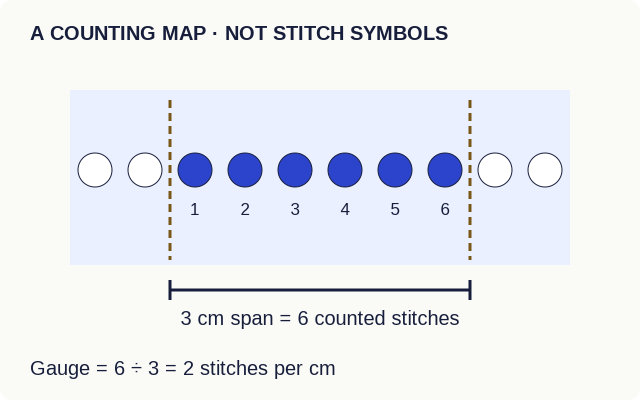
Thirty stitches at 2 stitches/cm occupy 15 cm; at 1.8 stitches/cm they occupy about 16.7 cm. A constant count can therefore accompany a wider piece. Compare central gauge windows before adding or removing stitches.
When answers seem to conflict
If you report fewer stitches but more width, or more stitches but less width, the helper asks you to recheck both measurements separately. It does not force that combination into a single explanation. A change of yarn, stitch pattern, hook or care condition may require a new comparison.
Keep a safe restart point
Before undoing work, write down the last verified row, the expected total and the discrepancy you can identify. Check a short corrected section before continuing. Do not hide an unresolved missing repeat by adding an arbitrary stitch at the edge or covering it with a border.
For persistent ambiguity, ask the pattern source about the exact row and convention. The local project record can keep your next action beside your measurements; it does not upload your notes.
Reference for count conventions and repeat notation: Craft Yarn Council: how to read a crochet pattern. The checks and numerical examples here are original explanations, not an assessment by a crochet instructor.