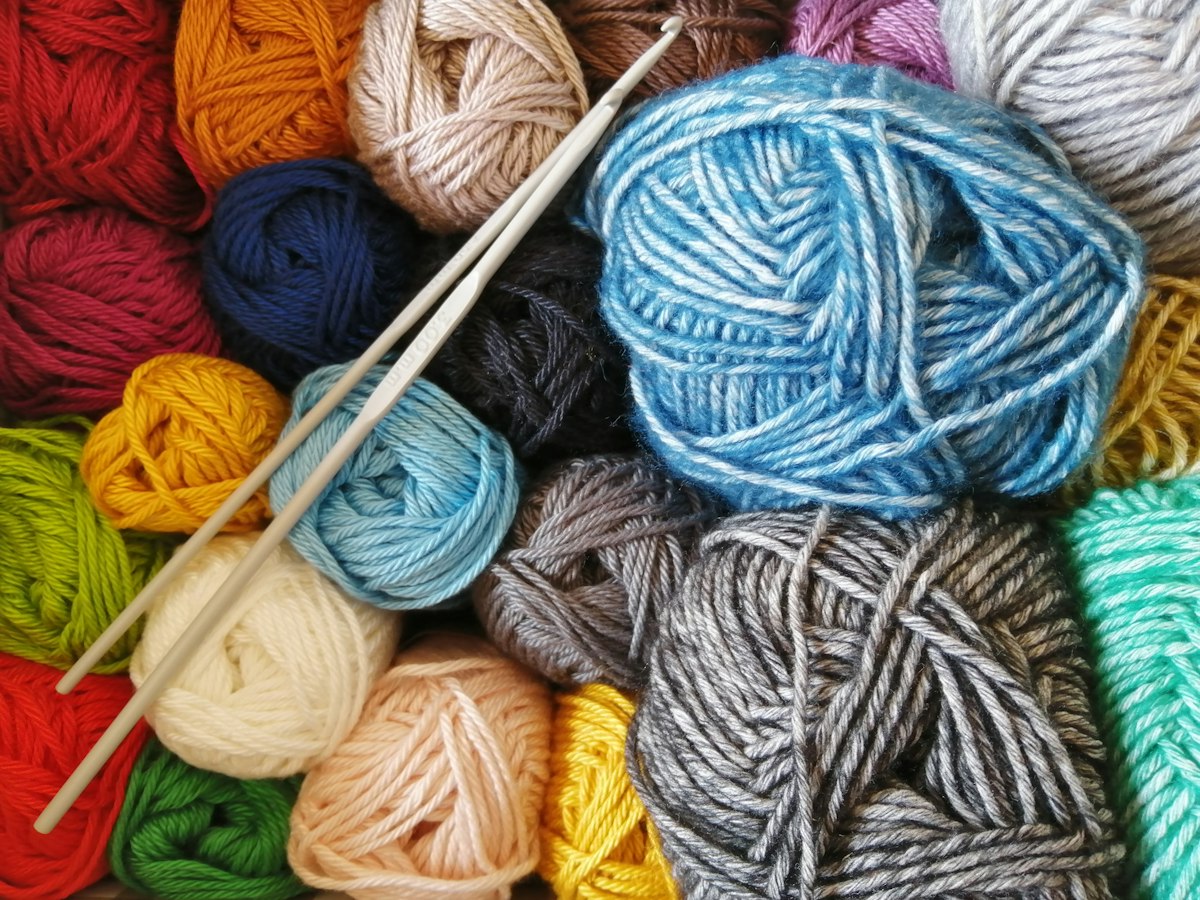
A ball on a scale gives you grams, not its thickness category or its remaining metres. This guide starts with that distinction, then shows how to estimate the length in a partly used ball when you still have its label. For an unidentified leftover, the calculation has no reliable conversion factor.
Three labels for three different questions
A thickness grouping: useful when searching for candidate yarns.
The mass on the scale: useful for tracking how much yarn remains.
Length: useful when comparing a pattern requirement with a supply.
A 100 g ball is not automatically thicker than a 50 g ball. They might be two pack sizes of the same yarn. Two 100 g balls of different products can contain different lengths.
A category is not a conversion factor
The Craft Yarn Council groups yarn thickness into categories 0–7. Its suggested gauge and hook ranges are guidelines, not a promise about a particular maker's fabric. Category names cannot tell you the metres in a 35 g remainder. Neither can a hook size, colour or photograph.
If you no longer know the product, keep the remainder for a small sample or a use that does not require a length estimate. Avoid assigning a label ratio from a different yarn just because the strands look similar.
A leftover calculation from start to finish
Use this invented label: 100 g / 220 m. Remove the paper band and weigh only the dry yarn. If a bowl is needed, tare the scale with the empty bowl first. Suppose the yarn reading is 35 g.
- Label ratio: 220 ÷ 100 = 2.2 m per gram.
- Estimated remaining length: 35 × 2.2 = 77 m.
- For a component estimated to use 70 m, the calculated difference is 7 m.
That 7 m is a nominal remainder, not a guarantee that you can finish the component. The original length, scale reading and component estimate all have uncertainty. Tails, joins and a change of fabric may use some of that difference.
| Yarn mass | Estimated length | Difference above a 70 m requirement |
|---|---|---|
| 34 g | 74.8 m | 4.8 m |
| 35 g | 77 m | 7 m |
| 36 g | 79.2 m | 9.2 m |
This is a what-if comparison, not a statement that your scale is accurate to ±1 g. Use the instrument's specifications and repeatable readings to judge the weighing uncertainty. A much larger sample is easier to weigh meaningfully than a few short strands.
Track actual consumption without mixing yarns
Weigh the same ball before and after a measured section. If it falls from 35 g to 29 g, the section used about 6 g, or 13.2 m at this label ratio. Make the section representative: include the usual tails if you want them reflected in the estimate, and note any yarn removed for another purpose.
Use separate records for different products even if their shades match. For a 100 g / 300 m yarn, the same 6 g change means about 18 m. There is no universal grams-to-metres conversion.
Choose what to do with a close result
If the estimated remainder only just covers the next component, check whether that component can be finished before you commit it to the project. Keep a compatible spare, revise the colour plan, or make a better representative sample. Do not round 74.8 m up to 80 m to make the plan fit.
Record the product, label ratio, yarn-only mass and the component you intend to make. The length converter changes metres to yards; it does not identify an unknown yarn. The label walkthrough explains which identity details to retain.
Reference for thickness categories: Craft Yarn Council. Leftover figures are original arithmetic examples, not measured results from a physical project.