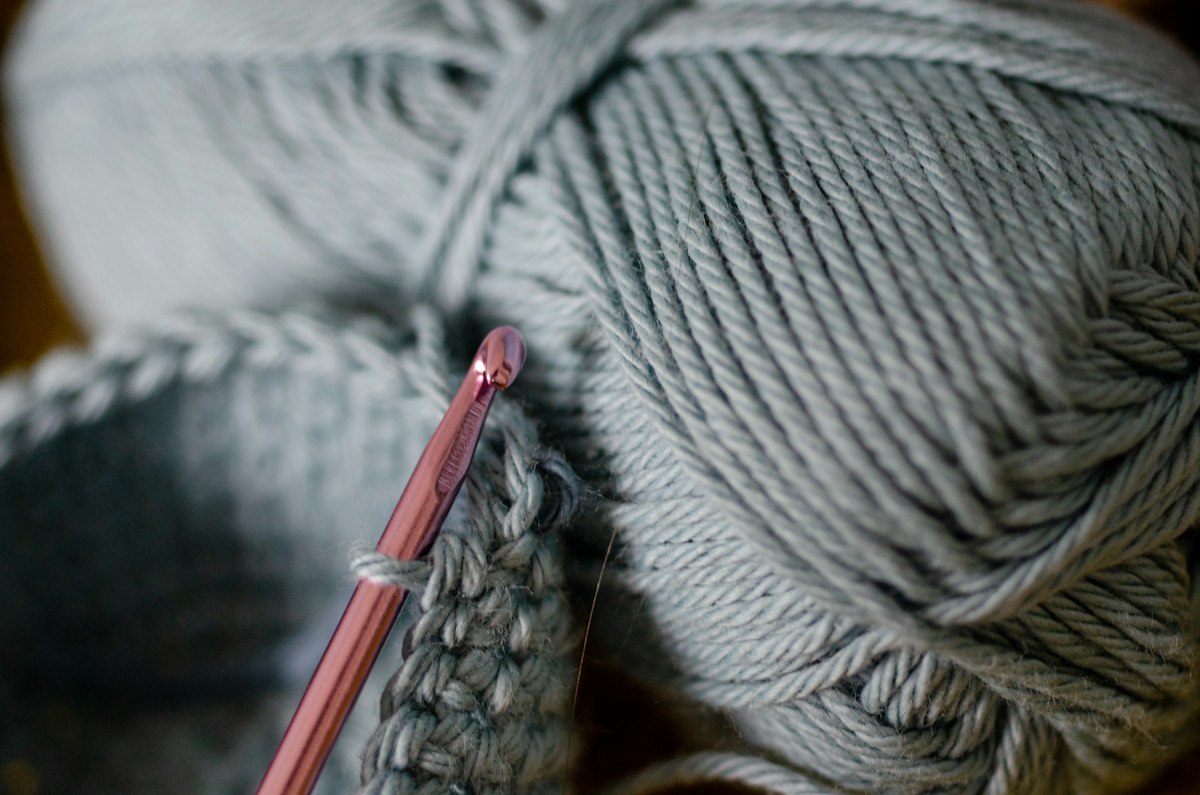
A suggested hook size is a starting point for making a sample. It does not guarantee a particular stitch count in your hands. The useful question is whether the hook produces the dimensions and fabric your project needs with your chosen yarn.
Identify the size in millimetres
Record the metric size stamped on the hook or listed by its manufacturer. Letter and number labels can vary between systems and brands. Our hook converter lists common ordinary-hook equivalents, but the actual product's stated millimetres should settle an uncertain label. Specialist steel hooks use other conventions and are outside that table.
Keep the hook with the project, or note the specific hook you used. Two hooks labelled the same size can feel different because of their shape and handle. If you switch halfway through a project, compare the resulting fabric before working a large new section.
Run a small, controlled comparison
Begin with the size suggested by the pattern. Make a sample in the specified stitch and measure it after the intended care. If you want to compare a neighbouring hook size, keep the yarn, stitch and finishing treatment the same. Label the samples immediately so you can tell which produced each result.
Record stitch gauge, row gauge and your impressions of the fabric. Does it bend the way you want? Are the gaps appropriate for the intended use? Can you form the stitches comfortably? These observations answer different questions; a good numerical match can still produce an unsuitable fabric.
See why a small gauge difference matters
Suppose sample A has 20 stitches per 10 cm and sample B has 18 per 10 cm. Across 90 stitches, A predicts 45 cm while B predicts 50 cm. The five-centimetre difference comes from the gauge, even though both samples may look similar on the table.
These are illustrative measurements, not a claim that a particular hook always creates either gauge. Enter your own results in the stitch calculator. For a fitted pattern, compare both stitch and row gauge with its requirements instead of simply changing the total count.
Make one change, then measure again
When you have too many stitches per measured distance, a larger hook may help produce larger stitches. Too few may call for a smaller one. Treat that as a direction to test, not a guaranteed correction. If width matches but height does not, the pattern's construction determines whether adjusting rows is appropriate.
Stop experimenting when the sample meets the relevant measurements and gives the fabric you need. Keep that sample and the notes until the project is finished. If no comfortable hook choice produces a suitable sample, reconsider the yarn or pattern pairing instead of forcing your grip or tension throughout the project.
Reference: Craft Yarn Council: hook sizing. For the measuring method, see our gauge guide.